


Form modernization in S/4HANA is not a marginal topic
With the foreseeable end of SAPscript support and the architectural limitations of Smart Forms, form modernization is becoming a real risk factor. Why a deliberate replacement strategy is crucial is explained in this blog post.
Why forms suddenly become critical in S/4HANA projects
Forms are among the most inconspicuous components of an SAP system. They run in the background and are rarely the focus of strategic discussions. In many organizations, SAPscript forms or Smart Forms are considered “working” and therefore treated as finished. Knowledge about these legacy objects is often limited to individual developers or to the fact that they are maintained via a specific SAPscript transaction—without transparent documentation of their business relevance, dependencies, or role in the overall process landscape.
At the latest during an S/4HANA transformation, however, this perception changes fundamentally. The move to S/4HANA does not only affect the data model and technical foundation, but also the architectural guidelines under which an SAP system is intended to operate in the long term. Concepts such as clean core, cloud readiness, or selective transformation are not abstract visions, but concrete requirements with direct implications for existing custom developments – and therefore also for forms.
At the same time, there is no universal silver bullet. Not every form needs to be modernized immediately, and not every organization benefits from a complete redesign. What matters is understanding the technological risks, consciously assessing the form landscape, and choosing a context-dependent replacement strategy. That is precisely the focus of this article.
SAPscript, Smart Forms, and Adobe Forms: more than just a technological sequence
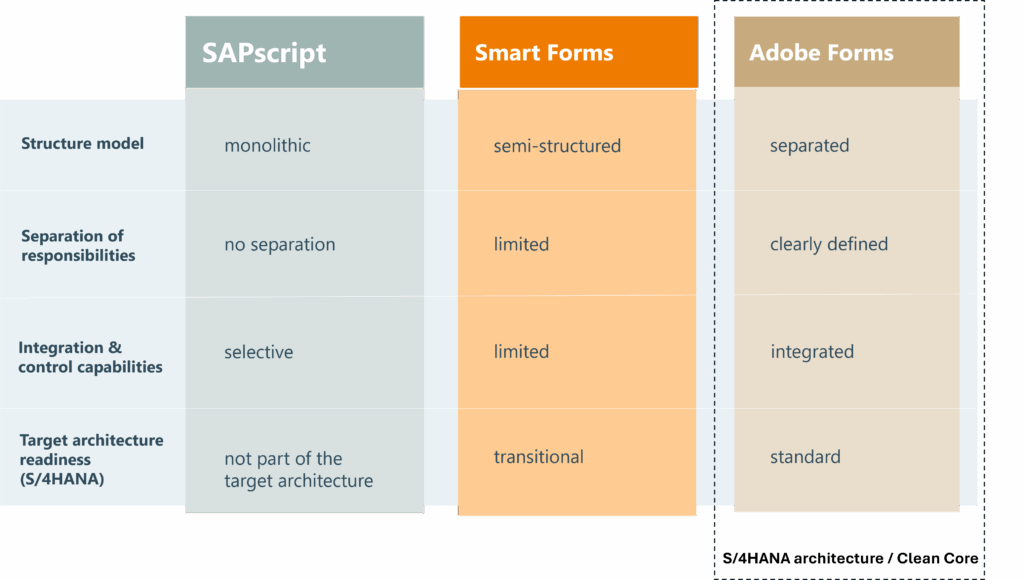
SAPscript is the oldest of the three technologies and dates back to the early R/3 era. Technically, it is a highly procedural, ABAP-centric solution in which layout, logic, and data access are insufficiently separated. Historically grown forms are often based on copied print programs, direct table access, and implicit business logic that has been extended over many years. Precisely because this logic is often only indirectly visible via the associated SAPscript transaction, risks and business dependencies are systematically underestimated in S/4HANA projects.
Smart Forms were introduced in the late 1990s and represented a significant step forward: a graphical designer, a clearer structure, and a certain decoupling of layout and logic. Nevertheless, Smart Forms remain tightly coupled to ABAP and do not follow a service-oriented architectural model.
Adobe Forms, finally, represent a true technological break. They are based on XML structures, clearly separate data, logic, and layout, and integrate seamlessly into modern SAP concepts such as Output Management, Fiori interfaces, and cloud scenarios. The fact that many SAP standard forms in S/4HANA are already delivered as Adobe Forms is a clear signal of SAP’s strategic target architecture.
Four key risks of legacy form technologies in the S/4HANA context
1. Violation of the clean-core approach
In practice, a SAPscript or Smart Forms form is rarely a pure presentation object. Instead, these forms often contain custom business logic, calculations, or direct table access. This logic is frequently undocumented, difficult to test, and not clearly attributable from a business perspective.
With S/4HANA, SAP consistently follows the clean-core approach: business logic belongs in clearly defined layers such as CDS views, services, or APIs—not in print programs or form logic. If historical forms are migrated without review, these hidden dependencies are imported directly into the new S/4 core.
The consequences often only become apparent during operations: updates become more complex, support packages cause conflicts, and every form change carries the risk of unexpected side effects. Maintenance effort increases while innovation capability declines. Selective modernization of critical forms—ideally using Adobe Interactive Forms with clearly defined data contracts—is a key lever for reducing technical debt.
Impact:
More complex updates, conflicts with support packages and releases, increasing maintenance effort.
Solution approach:
A clearly defined and documented data exchange between the ABAP backend and the Adobe Form, without hidden dependencies or logic in the form itself.
2. Technological dead end and loss of expertise
SAPscript is no longer being enhanced, and the same applies to Smart Forms. Modern requirements such as e-invoicing, digital signatures, structured electronic documents, or cloud operation can only be implemented to a limited extent – or not at all -using these technologies.
At the same time, available expertise is declining. Developers who are proficient in SAPscript or complex Smart Forms scenarios are becoming increasingly rare. As a result, companies face growing dependency on individual experts or external specialists. For business-critical processes, this represents a significant risk.
A deliberate replacement where regulatory requirements, customer communication, or future process digitalization are affected reduces these dependencies and creates long-term operational stability.
Impact:
Growing dependency on individuals, increasing operational risks.
Solution approach:
Targeted replacement where regulatory or business-critical requirements exist.
3. Testing, operations, and compliance risks
Legacy forms are usually difficult to test, poorly versioned, and hard to automate. In modern S/4HANA projects with iterative testing cycles and parallel system landscapes, this quickly becomes a bottleneck. The interaction with data protection requirements is particularly critical: productive personal data may only be used to a limited extent in test and training systems.
Historical forms are often not designed for this. They expect real names, addresses, or bank details and react unpredictably to anonymized data. This leads to unstable tests, delays, and real compliance risks.
Adobe Forms, combined with a structured test data and anonymization concept, enable a clean separation between productive use and GDPR-compliant quality assurance.
Impact:
Unreliable tests, delays, data protection gaps.
Solution approach:
Adobe Forms combined with a robust test data and anonymization concept.
4. Risks in selective transformation and SLO scenarios
In selective transformations, carve-outs, or system consolidations, form-related issues become particularly evident. Forms often reference organizational structures, business partners, or transaction data that are intentionally no longer present in the target system.
The result is runtime errors in the output process, which are often only discovered during cutover or shortly after go-live. Particularly critical is the fact that these errors are not always technically obvious: documents are generated but contain incorrect or incomplete business information. For invoices or legally relevant documents, this can have serious consequences.
Impact:
Go-live risks, hectic rework, business disruptions..
Solutions approach:
Include forms early in SLO analyses and define clear target states.
A viable approach is to involve forms early in SLO analyses and explicitly clarify which documents are required in the target system, which data they depend on, and how they fit into the overall target architecture.
Adobe Forms as a strategic building block in S/4HANA
Adobe Forms are now the de facto standard for new SAP forms. They not only provide a more modern appearance but also enable interactive, dynamic documents with graphics, barcodes, tables, and user input. Digital signatures and electronic document processes can be seamlessly integrated.
From a maintenance perspective, companies benefit from clear structures, centralized control, and improved multilingual support. Layout changes or adjustments to individual form components can be implemented in a targeted manner and with significantly less effort than with classic SAPscript forms, while business logic continues to reside in ABAP. This is a major advantage, especially for internationally operating organizations.
Three legitimate replacement strategies
In practice, three strategies have become established:
- Lift & Tolerate means initially migrating existing SAPscript or Smart Forms and only making minimal adjustments. This is suitable for rarely used, internal, or phasing-out documents – while consciously accepting technical debt.
- Selective modernization is the most pragmatic approach in most brownfield and selective S/4HANA transformations. Business-critical or regulatory-relevant forms are modernized, while non-critical forms remain unchanged for the time being. Effort, risk, and future readiness are balanced in this approach.
- Complete redesign is only appropriate in clearly defined scenarios, such as greenfield approaches or highly regulated industries with strong governance and sufficient budget.
Conclusion: Forms are an architectural litmus test
SAPscript and Smart Forms are not merely legacy layout artifacts, but carriers of historical business logic and technical debt. In S/4HANA transformations, they play a decisive role in update capability, cloud options, and project risk.
The key question is therefore not whether forms should be modernized, but when, to what extent, and with which strategy. Addressing the topic early and prioritizing it consciously reduces risks, avoids costly rework, and creates a solid foundation for future innovation.
Form modernization is therefore not a cosmetic exercise, but a business-critical component of any sustainable S/4HANA architecture.