

SAP S/4HANA: Advanced Returns Processing via BKP
Returns are no longer just an annoying by-product of doing business—they have become a strategic lever for customer satisfaction, cost optimization, and brand perception.
Whether in consumer goods, mechanical engineering, or the electronics industry, returns are inevitable. The question is not if, but how they are handled.
In many companies, recent years have shown that unstructured or manually controlled returns processing is not only costly, but also puts valuable customer relationships at risk. At the same time, pressure from customers is increasing:
Customers expect fast, transparent, and error-free processing—regardless of whether they are end customers or business partners.
Advanced returns processing in S/4HANA
With “Advanced Returns Processing” in S/4HANA via Inventory Control Processes (BKP), SAP provides a solution that helps companies manage returns efficiently, transparently, and in an integrated manner. The key advantage: it covers both customer returns and supplier returns, while linking logistics, quality-related, and financial processes in a single, end-to-end workflow.
1. Lack of process standardization in returns processing – an underestimated risk
A practical example: In an industrial company selling machine components, returns processing has evolved inconsistently over the years. Each clerk follows their own approach: in some cases, goods receipt is recorded first; in others, quality inspection begins immediately; in some instances, a credit memo is even issued directly without prior inspection. The consequence: processing times vary widely – from two days to two weeks – without any comprehensible reason for customers or internal stakeholders.
Impact: Loss of time, inquiries, erosion of trust
This lack of standardization has noticeable effects. Varying procedures lead to significant fluctuations in throughput times. At the same time, inquiries increase due to the absence of a uniform information status. Customer expectations are often not met, which in the medium term results in loss of trust and reputational damage.
Solution: structured process with SAP S/4HANA
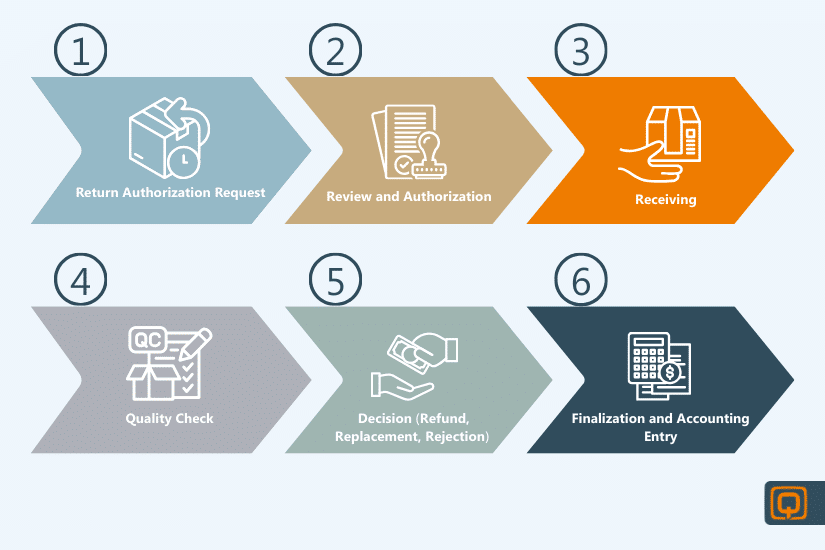
The solution lies in implementing advanced returns processing using SAP S/4HANA Inventory Control Processes (BKP). This establishes a clearly defined, system-supported process that guides all returns through six consecutive steps.
Binding workflows through system support
Because each step is system-supported and mandatory, no activities can be skipped or bypassed. Regardless of which employee handles a particular case, this ensures consistent processing quality with clearly defined responsibilities.
As a result of the standardized workflow, processing times were significantly reduced and sources of error minimized. At the same time, traceability increased for all stakeholders—both internal and external. Customers benefit from clear response times and consistent communication, while the company benefits from higher efficiency and noticeably improved customer retention.
2. Lack of integration between logistics, quality, and finance – practical example
In a trading company, returns were initially posted in the warehouse, while quality inspection was carried out in a separate system. Accounting, in turn, often received the relevant information via email attachments. This fragmented, media-disrupted communication resulted in credit memos frequently being issued only after several weeks -with tangible negative effects on customer loyalty and internal efficiency.
Impact: susceptibility to errors, delays, lack of transparency
The parallel use of non-integrated systems caused duplicate data entry, increased error rates, and complicated coordination between departments. Financial processes were unnecessarily delayed, inquiries accumulated, and a real-time view of processing status was impossible. The result: a fragmented process with unclear responsibilities and high coordination effort.
Solution: integrated workflow with SAP S/4HANA BKP
By introducing advanced returns processing based on SAP S/4HANA BKP, logistics, quality management, and finance were combined into a seamless digital workflow:
- Inventory movements in the warehouse are executed automatically
- Inspection results flow directly into decision-making
- Credit memos or debit postings are triggered immediately
By integrating all relevant areas, a continuous flow of information is created—without media breaks. All stakeholders work on the same data basis and are always informed about the current process status. This enables faster processing, reduced error rates, and an improved customer experience through transparent and timely returns handling.
3. Limited traceability and lack of process transparency – another example
A medical technology company faces a puzzling phenomenon: individual returns repeatedly remain unprocessed for weeks or even months. Manual tracing eventually reveals the cause—the shipments arrived at the warehouse, but the quality inspection was simply forgotten. Without process transparency, such cases remain undetected and unnecessarily block warehouse capacity.
Impact: blocked resources, additional costs, dissatisfaction
The lack of traceability not only led to delayed returns processing, but also caused additional operational costs—for example, due to unnecessarily occupied storage space or repeated customer inquiries. Poor data quality also complicates root cause analysis and prevents systematic learning from process deviations.
Solution: end-to-end traceability with SAP S/4HANA
- BKP documents every processing step with timestamp and responsible party
- Status overviews and worklists allow bottlenecks to be identified immediately
- Managers can intervene in a targeted manner before escalations occur
Thanks to clear worklists and real-time status displays, bottlenecks or delays can be identified at an early stage. Managers are able to intervene proactively and in a timely manner—before backlogs escalate or negative customer experiences arise. The result: higher process reliability, less wasted effort, and significantly improved controllability.
4. Problem: high error rate in returns processing
In an electronics company, returns were repeatedly sent to the wrong suppliers. The reason: when recording defective devices, a mandatory field for supplier selection was missing. Without system-supported checks or plausibility validations, incorrect data was accepted—resulting in costly consequences for logistics and claims processing.
Impact: additional costs, delays, increased effort
Shipping to incorrect addresses not only caused direct additional costs, but also significantly delayed complaint handling. At the same time, the logistics department was burdened with rework and clarification cases—unnecessary effort that could have been avoided with the right control mechanisms.
Solution approach using advanced returns processing (BKP) in S/4HANA
- BKP guides users step by step through the process
- Mandatory fields prevent missing information
- Validations check plausibility (e.g., material–supplier relationship)
These intelligent control mechanisms reduce typical data entry errors at the very beginning of the process and thus prevent costly downstream errors. Returns processing becomes more reliable, more transparent, and significantly more efficient—a win for everyone involved along the process chain.
Implementing advanced returns processing in S/4HANA – approach
Introducing advanced returns processing in S/4HANA is not a “push-button project.” It requires careful analysis, customization, and change management.
1. Current-state analysis & process documentation
The project begins with a structured assessment of existing processes and responsibilities. Media breaks as well as organizational or technical bottlenecks are identified. In addition, current process costs and throughput times are evaluated to establish a solid baseline for later optimization.
2. Target definition & process design
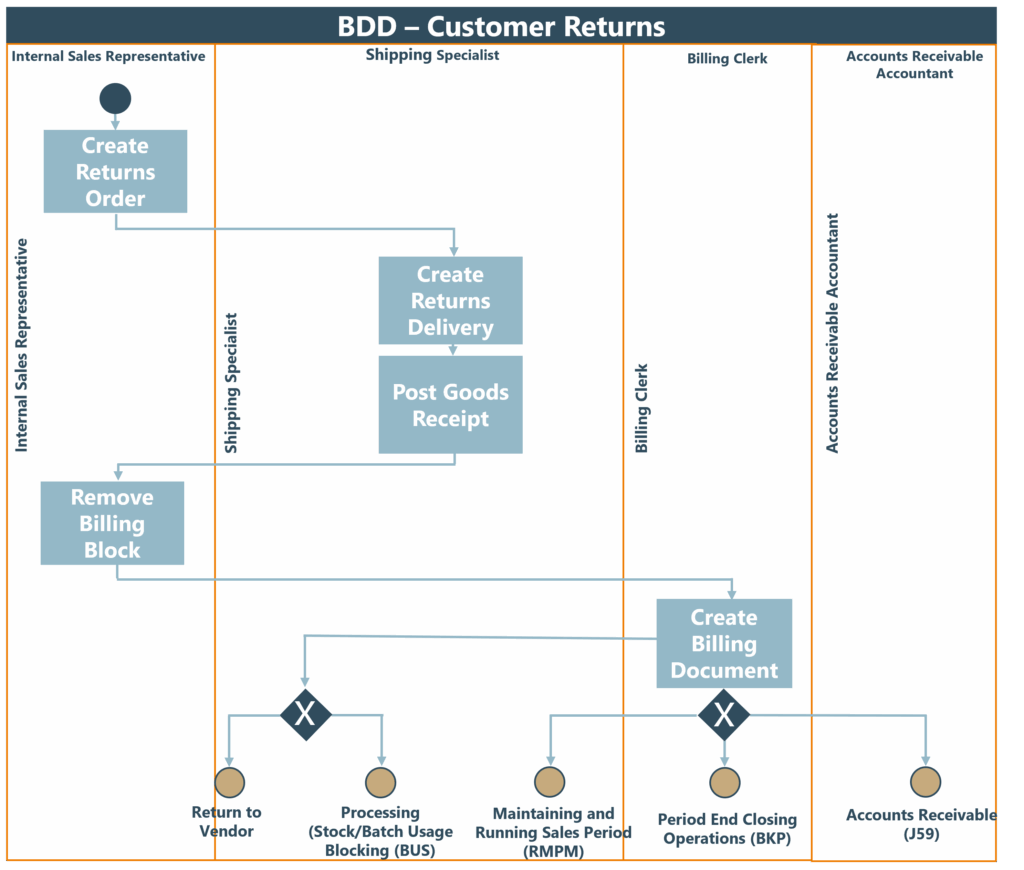
In the next step, the existing process is compared with the SAP S/4HANA BKP standard process. Based on this comparison, additional inspection and approval steps are defined where necessary. At the same time, concrete target metrics – such as maximum processing times (KPIs) – are established to enable later success measurement.
3. System setup & integration
Technical implementation begins with activating BKP in customizing. The system is then integrated with relevant modules such as Logistics, Quality Management (QM), and Finance (FI/CO). User roles and authorizations are also defined to ensure that all participants can access exactly the tasks relevant to them in the process.
4. Testing phase & training
The new returns process is first tested in a pilot phase using representative return scenarios. In parallel, users receive hands-on training, including typical use cases. Feedback loops are also established at this stage to implement necessary fine-tuning at an early point.
5. Go-live & optimization
After successful testing, the new process is rolled out to additional sites or departments. Continuous monitoring of defined KPIs enables rapid identification of deviations or optimization potential. Based on ongoing feedback and process analysis, the solution is further refined and sustainably embedded within the organization.
Key performance indicators (KPIs) for success measurement
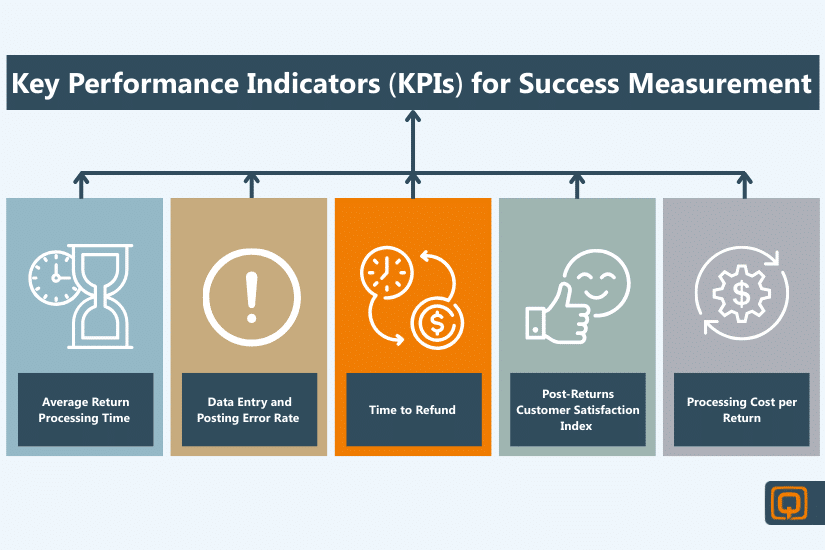
These KPIs can be monitored in real time in SAP S/4HANA using analytical apps and provide a solid basis for process optimization.
Support through software tools and consulting
- Process mining: analysis of throughput times and bottlenecks
- Workflow monitoring: real-time monitoring of return statuses
- Change management tools: ensuring user adoption
An experienced SAP consultant contributes not only technical expertise, but also best practices from similar projects. This prevents costly wrong decisions and significantly shortens implementation time.
Best practices from project experience
- Early involvement of all stakeholders
- Small pilot groups instead of a big-bang approach
- Stay as close to standard as possible to ensure upgradeability
- KPI-based monitoring from day one
- Training using real scenarios instead of theoretical examples
Conclusion: Returns management – form cost factor to competitive advantage
Advanced returns processing with SAP S/4HANA is far more than a technical option—it is a strategic lever for efficiency, transparency, and customer satisfaction. Companies that actively integrate the returns process into their IT and process landscape gain clear advantages: shorter processing times, fewer errors, lower costs, and reliable data for sound decision-making.
Those who treat returns merely as an operational obligation risk customer losses and rising costs in the long run. Those who optimize the process deliberately, on the other hand, create differentiation potential—and thus real market opportunities.